Modularizing AI Intelligence: Building Portable Skills with MCP
I. Introduction: The Evolution of Agentic Workflows
In the current landscape of AI-assisted development, a fundamental shift is underway: we are moving away from monolithic, "all-knowing" system prompts toward a more sustainable architecture based on tool orchestration.
For many developers, the initial excitement of LLMs often leads to "context bloat," where agents are fed massive, static instruction sets that struggle to handle real-world infrastructure complexity. The solution to this is not more prompt engineering, but rather modular intelligence. By treating specialized capabilities as atomic, portable Skills, we can transform an LLM from a generic assistant into a surgical, reliable participant in our technical workflows.
Central to this evolution is the Model Context Protocol (MCP). MCP provides the universal language that allows these skills to be defined once and executed across any compatible AI client. In this post, we explore how defining operational tasks as discrete, version-controlled skills enables an agent to move confidently between a repository audit, a secrets management check, and a network security hardening task—ensuring consistency and security without the overhead of manual verification.
II. The Anatomy of an MCP Skill
A "Skill" is more than just a script; it is a contract between the LLM and your local environment. An effective MCP-compliant skill consists of three core components:
- Atomic Design: Each skill is a discrete, testable, and reusable function that performs one specific task well.
- Standardized Interfaces: MCP servers expose these capabilities as standardized tools, allowing the LLM to understand exactly what inputs are required and what actions will be performed.
- Security & Governance as Code: Skills are not passive; they include built-in verification checkpoints, ensuring that sensitive operations are performed safely and consistently every time.
III. Implementing the Architecture
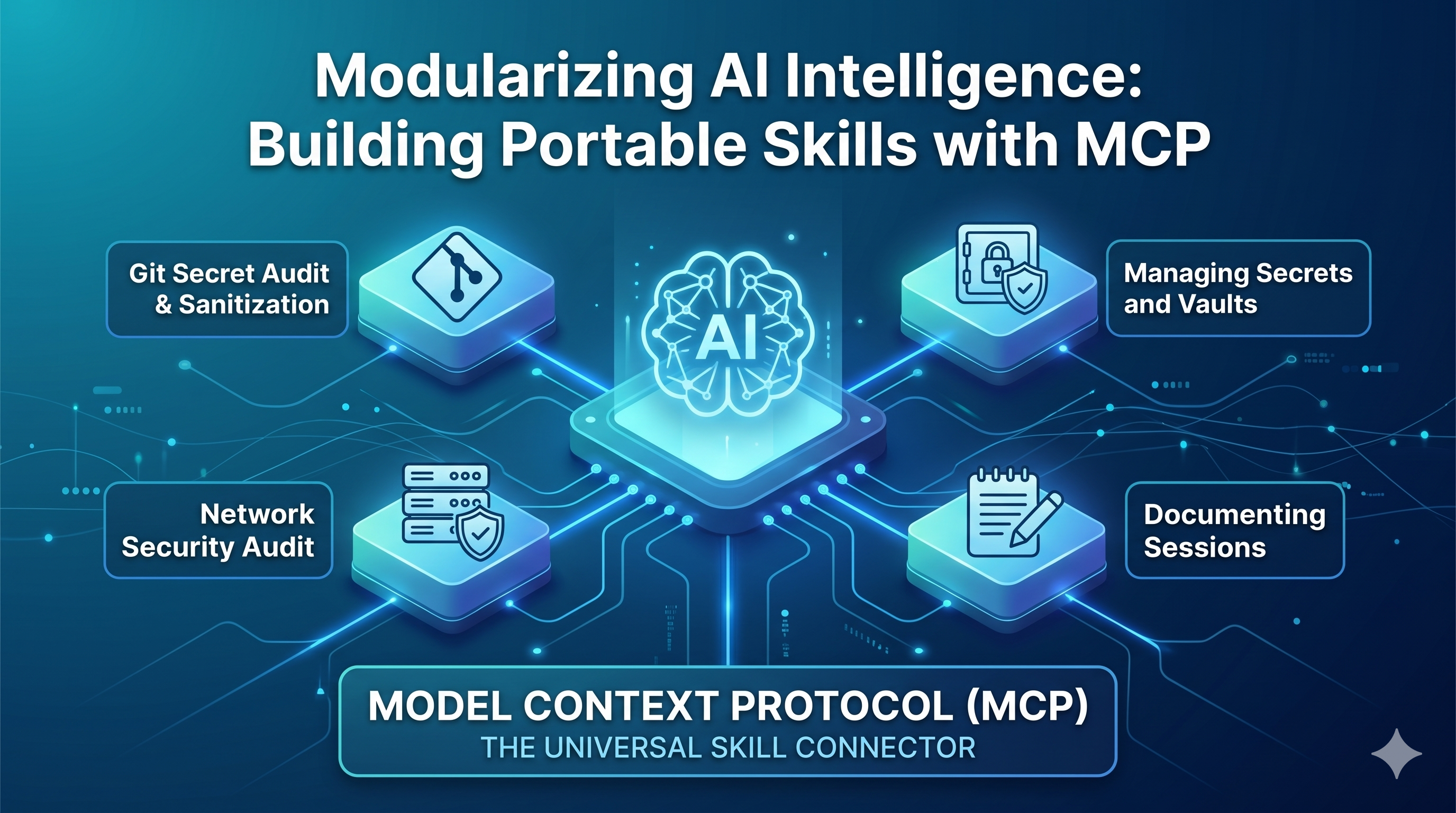
To maintain a clean and effective environment, we categorize skills into distinct operational domains:
- Version Control & Repository Governance: The Git Secret Audit & Sanitization skill acts as the first line of defense, ensuring that sensitive data never persists in the history of your projects.
- Secrets & Environmental Integrity: The Managing Secrets and Vaults skill provides the "governance" logic—enforcing how credentials should be loaded and managed through secure vault integrations rather than flat files.
- Network Infrastructure Hardening: The General Network Security Audit skill extends these security principles to network hardware by identifying legacy protocols and unused ports.
- Operational Transparency: The Documenting Sessions (docum-md) skill provides a self-documenting loop. By automatically tracking work logs in a private, git-ignored directory, it captures decisions and technical context without cluttering the repository.
The Workflow Advantage
Defining these as MCP-compliant skills allows the agent to handle the entire lifecycle of a development task:
1. Reflect: Automatically log the session's achievements and decisions. 2. Sanitize: Run the Git Secret Audit & Sanitization skill before any commit to ensure no secrets have leaked into the staging area. 3. Harden: Periodically execute the General Network Security Audit or Managing Secrets and Vaults skill to ensure the project's foundation remains secure.
IV. Best Practices for Building Skills
Creating robust, reusable skills requires more than just functional code; it requires a focus on maintainability and smart design. Inspired by the principles of building modular AI systems, such as those discussed in this video, here are key practices for maintaining a high-quality skill library:
- Design for Atomic Complexity: Start simple and evolve. Manage complexity by scaling from basic automation tasks up to sophisticated systems that process data backlogs.
- Prioritize Reusability: Treat each skill as a standalone "cheat code." By ensuring skills are self-contained, you make them easily transferable across different projects and AI clients.
- Implement Governance Early: Even in simple skills, build in security and auditability. Use secure patterns to ensure that credentials are never exposed, regardless of the task complexity.
- Automate Your Documentation: Treat your development process as a data stream. Keeping a private, git-ignored record of your work helps you iterate faster because you always have a history of what was built and why.
- Modularize and Decouple: Use the Model Context Protocol (MCP) to keep your tools and infrastructure separate from your LLM logic. This ensures you can upgrade models without rewriting your entire library of skills.
V. Conclusion: Codifying Your Workflow
The transition from manual, ad-hoc task management to a library of standardized skills represents a fundamental maturity step. By shifting to a unified ecosystem where every operation is a portable, MCP-compliant skill, you reduce cognitive load and increase the reliability of your automated processes.
The beauty of this architecture is that it is additive. You don't need to overhaul your entire environment at once. You can start by identifying one repetitive task, defining it as an atomic skill, and porting it to an MCP server. As your library of skills grows, you will find that your agents become more predictable, secure, and easier to maintain. You are no longer just "using AI"; you are architecting a sustainable, automated environment that evolves alongside your technical needs.
Ready to start building your own skill library? Begin by documenting your most common manual task, define it as an atomic skill, and consider how the Model Context Protocol can help you standardize it for your future workflows.

Discussion
No comments yet. Be the first to share your thoughts!
You must be logged in to leave a comment.
Sign In